
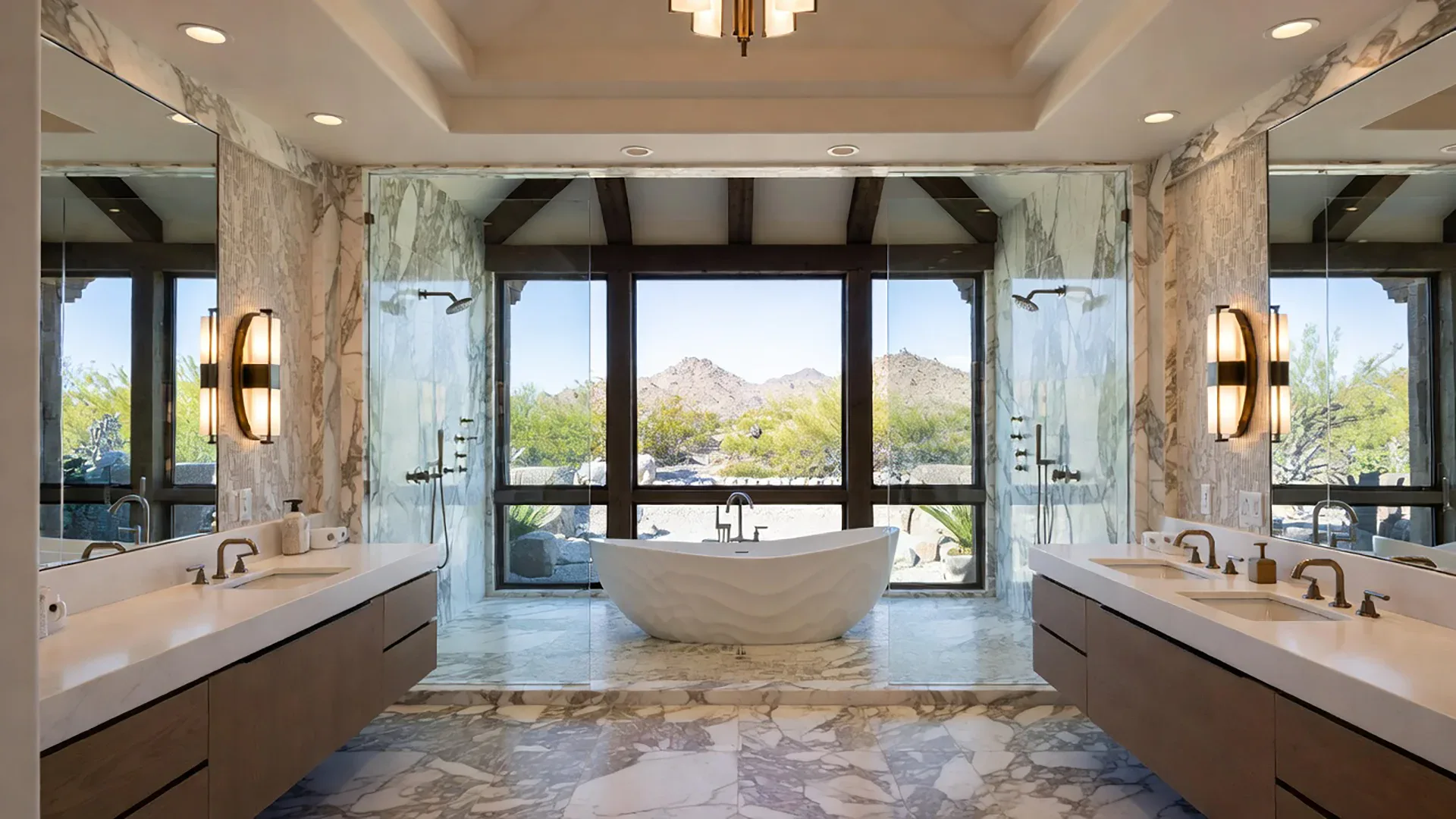
If you’re weighing which home improvement project delivers the best return, bathrooms consistently rank near the top. In Arizona’s competitive real estate market — where buyers expect updated interiors and spa-quality finishes — a well-executed bathroom remodel can return 60–80% of its cost at resale while improving your daily quality of life in the meantime.
This guide covers everything you need to know before starting a bathroom remodel in Arizona in 2026: realistic costs, what drives them, current design trends, permit requirements, and how to find the right contractor.
What Does a Bathroom Remodel Cost in Arizona in 2026?
| Project Type | Typical Cost Range |
|---|---|
| Secondary / Guest Bath Remodel | $15,000 – $30,000 |
| Primary Bath Remodel (Mid-Range) | $25,000 – $45,000 |
| Primary Bath Remodel (High-End) | $45,000 – $80,000 |
| Primary Bath Remodel (Luxury) | $80,000 – $150,000+ |
The sweet spot for most Arizona homeowners pursuing a quality primary bath remodel falls between $35,000 and $60,000. At that range, you’re working with premium tile, quality fixtures, a frameless glass enclosure, and a contractor with the experience to execute it cleanly — without cutting corners on waterproofing, substrate, or layout.
Projects below $15,000 rarely produce results worth the disruption. Cosmetic surface work over aging infrastructure tends to compound into larger problems within a few years.
What Drives the Cost of a Bathroom Remodel?
Layout Changes and Plumbing Moves
Moving a toilet, shower, or tub requires rerouting supply and drain lines — work that adds significant labor and material cost. If your remodel keeps plumbing in place, costs stay lower. If you want to reconfigure the layout, budget for it and make sure your contractor accounts for it in the written proposal.
Tile Selection and Coverage
Tile is often the single largest material cost in a bathroom remodel. Large-format porcelain slabs (24×48 or larger) require precise installation, specialty cutting equipment, and more skilled labor than standard tile. Floor-to-ceiling tile in a shower enclosure versus a tiled niche represents a wide cost gap — direct your budget toward the surfaces that matter most visually.
Shower vs. Tub
A custom tile shower with a linear drain, bench, and frameless glass enclosure typically costs more than a tub surround but is often the right call for primary bathrooms where the shower gets daily use. Freestanding soaking tubs have become a premium design feature — they add cost for both the fixture and the plumbing rough-in but deliver undeniable visual impact.
Fixtures and Hardware
The gap between builder-grade and mid-to-high-end plumbing fixtures is significant. Quality faucets, shower systems, and hardware from brands like Kohler, Hansgrohe, or Brizo last longer, function better, and finish spaces in a way that budget fixtures simply don’t. This is not an area to economize on a premium remodel.
Vanity and Storage
Custom or semi-custom cabinetry with solid wood construction, dovetail drawers, and soft-close hardware sits in a different category than stock vanity boxes. If your bathroom has an unusual layout or you want built-in storage that works with the architecture, custom millwork is worth the investment.
Popular Bathroom Design Trends in Arizona for 2026
Large-Format Tile
Large porcelain slabs — 24×48, 48×48, and book-matched panels — continue to dominate high-end bathroom remodels. Fewer grout lines create a cleaner look and are easier to maintain, which suits the Arizona lifestyle well.
Frameless Glass Enclosures
Frameless shower glass has moved from an upgrade to an expectation in mid-to-high end remodels. It opens up the visual space, lets tile work take center stage, and holds up better over time than framed alternatives that collect moisture in the channels.
Freestanding Soaking Tubs
A freestanding tub positioned as a focal point signals luxury in a way few other single fixtures can. Oval and sculptural forms in matte white or warm stone textures are particularly popular in 2026.
Spa-Like Showers
Walk-in showers with multiple body sprays, a rain head, a handheld, and a linear drain have replaced the basic single-head shower as the standard for primary bathrooms at this price point. Steam units are an increasingly common addition.
Warm Neutral Tones
Cool grays have given way to warmer palettes — greige, warm white, terracotta undertones, and natural stone looks that complement Arizona’s desert landscape. These tones age well and photograph beautifully for resale.
Do You Need a Permit for a Bathroom Remodel in Arizona?
Yes — in most cases, a meaningful bathroom remodel requires a permit. Arizona cities including Gilbert, Chandler, Mesa, Scottsdale, and Phoenix all require permits for work that involves:
- Plumbing modifications (moving or adding supply or drain lines)
- Electrical work (adding circuits, outlets, exhaust fans, or lighting)
- Structural changes (moving walls, widening doorways)
- HVAC modifications
Work that is purely cosmetic — swapping out a vanity with the same plumbing connections, replacing tile like-for-like, installing a new mirror — may not require a permit. But if your contractor is doing anything beyond surface cosmetics, the permit is required.
Be cautious of any contractor who suggests skipping permits to save time or money. Unpermitted work creates problems at resale, may void homeowner’s insurance, and can require demolition and re-inspection to remediate.
How to Choose the Right Bathroom Remodel Contractor in Arizona
Verify the ROC License
Arizona’s Registrar of Contractors (ROC) licenses all residential contractors. Verify the contractor’s ROC number at roc.az.gov and confirm the license is active and in good standing. A KB-1 license covers residential general contracting and is the appropriate credential for a full bathroom remodel.
Ask About Their Experience with Similar Projects
Ask to see photos of completed bathroom remodels at a similar scope and price point. Ask how many bathroom remodels they complete per year. A contractor who has executed dozens of custom tile showers handles the details differently than one who does them occasionally.
Require a Written, Itemized Proposal
A professional contractor provides a detailed written proposal specifying scope of work, materials, allowances, timeline, payment schedule, and what is and isn’t included. Vague proposals lead to disputes — get everything in writing.
Understand Who Is Actually Doing the Work
Ask directly whether the contractor self-performs critical work or subcontracts everything. Know who will be in your home, who is responsible for quality, and how the contractor manages their trades.
Why Homeowners Choose Solid State Construction for Bathroom Remodels
Solid State Construction is a Gilbert-based, family-owned, minority-owned remodeling company serving homeowners across Arizona. Founded by brothers Sonny and Sean Saldua, the company has built its reputation on mid-to-high end renovations where craftsmanship and attention to detail aren’t negotiable.
Co-owner Sean Saldua brings HGTV production experience to every project — a design perspective that shapes how Solid State approaches material selection, layout, and the small details that separate a bathroom that photographs well from one that feels exceptional to live in every day.
Solid State holds ROC KB-1 license #344966 and is MBE-certified. Every project begins with a thorough consultation, a detailed written proposal, and a clear timeline — so you know exactly what you’re getting before a single tile is ordered.
Call (480) 900-0921 or request a free quote at solidstateconstructionaz.com/get-a-quote. We serve homeowners throughout Arizona.